

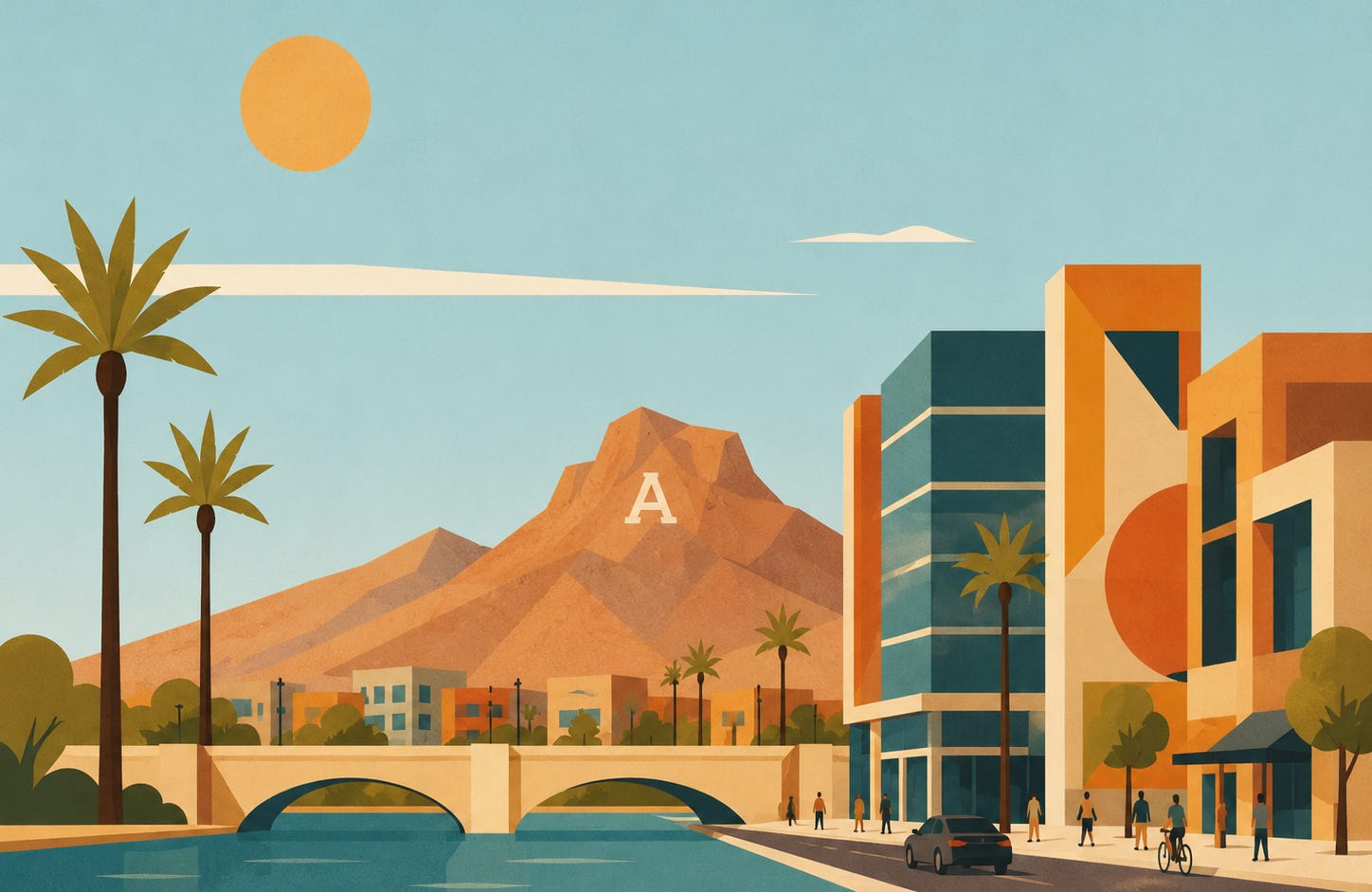
Below is a very short essay I wrote for what was to become a printed magazine published by residents of Tempe, Arizona (the college town where Arizona State University is situated). The magazine never got off the ground, but I didn’t want these words to go to waste—particularly because its animating theme (localism) is, ironically, quite universal. Without further ado:
The idea of a “local” paper, or magazine, or periodical seems pretty quaint to us. I mean, at least to those of us living out West, where every other person we know came here yesterday, and may well leave tomorrow. If the zeitgeist of our age is one of movement, mobility, and rootlessness—and therefore also one of displacement, isolation, and alienation—then we are in the land where that zeitgeist is most truly itself. Tocqueville recognized that America was the consummation of democracy and its spirit of equality. The American West is the consummation of our contemporary restlessness.
Again, the idea of “local,” to us, often seems like a quaint dream bound up with nostalgia. Our parents, or our grandparents, or our great grandparents enjoyed the local diner, the local movie theater, the local dive bar, the local paper. But all of us—college students, young professionals, urban cowboys, suburban renegades—we’ve lost all that. We’ve either moved on from a parochial past, or declined from a golden age, or however you want to frame it. The bottom line is that we frequent Starbucks, Whole Foods, and Chipotle, and we like it that way. No reason to feel any shame about it.
I will be the first to admit that there’s a certain comfort I feel in visiting a Starbucks in Huntington Beach, Arlington, or Cairo and it feeling just like I’m back at the Starbucks off South Forest Ave. We might visit a thrift shop or an old haunt that’s miraculously survived the acceleration of globalization to show that we actually care about what once was called “local.” These places warm our hearts, for sure, but we are always drawn back out into the “real world” of commotion and the next big thing.
No matter the almost inevitable placelessness of our modern situation, we cannot lose sight of an important fact (it may well be the most important fact of our lives): We come from somewhere. We live somewhere. Our lives, no matter how bound up in constant movement, constant motion, constant striving, are lived in space and in time. No innovation in economics, physics, or biology will ever erase those basic restrictions on our existences. We are contingent upon a near infinite array of variables, and bound by more things outside of ourselves than we can imagine.
This is all to say that there will always be something local about each of us, and we’d be well advised to seek a recovery of the “local” in our lives and in our shared life.
We have the ironic privilege of our local community being the pinnacle of rootlessness. That means we have the unique opportunity to patch a new quilt together based on the remnants we find lying around. It means that more than conserving a treasured past, we’re blessed to imagine a new future; to build a legacy that one day our children and grandchildren will be able to call their inheritance.
Like Saint Benedict during the twilight of the Roman Empire, we are called on to build a beachhead for the future here in the present. While I certainly hope our efforts are more fruitful than Comrade Lanski’s, this magazine attempts to live up to what the great American novelist Joan Didion claimed was the summation of Lanski’s organizing in her collection of essays titled Slouching Towards Bethlehem: “a minor but perilous triumph of being over nothingness.”
This magazine is one small contribution towards this broader mission, one which more people from every angle ought to think more about, and contribute more to. This magazine, if all goes well, will be something truly local. That’s worth cherishing.