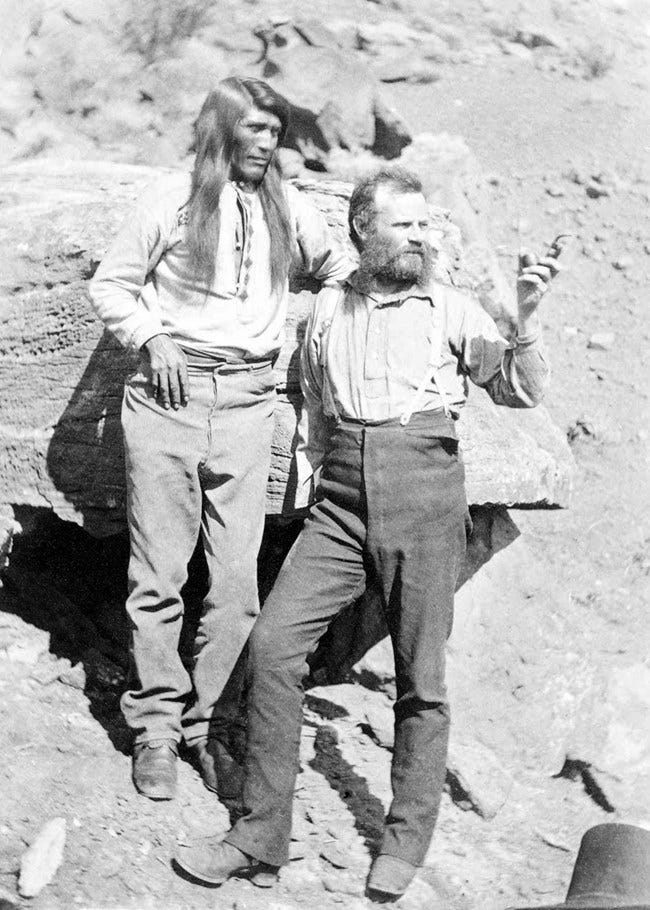
Friends, earlier this week I published this essay for the Western Tribune (a subsidiary of the 1912 Institute, where I serve as Board Chair). I’m reposting it here so that you can read it via my personal newsletter.
If you’re interested in this sort of content, I encourage you to become a free subscriber to the Western Tribune and a paid subscriber to the 1912 Institute. Paid subscribers get access to paywalled Tribune content, quarterly editions of the 1912 Review (a forthcoming print magazine), an exclusive “Ditat Deus” (“God Enriches” — Arizona’s state motto) ball cap (see below), and free and discounted access to in-person events in AZ (and occasionally in DC and NYC). We’re offering a discounted price for members who join soon. Don’t miss out!

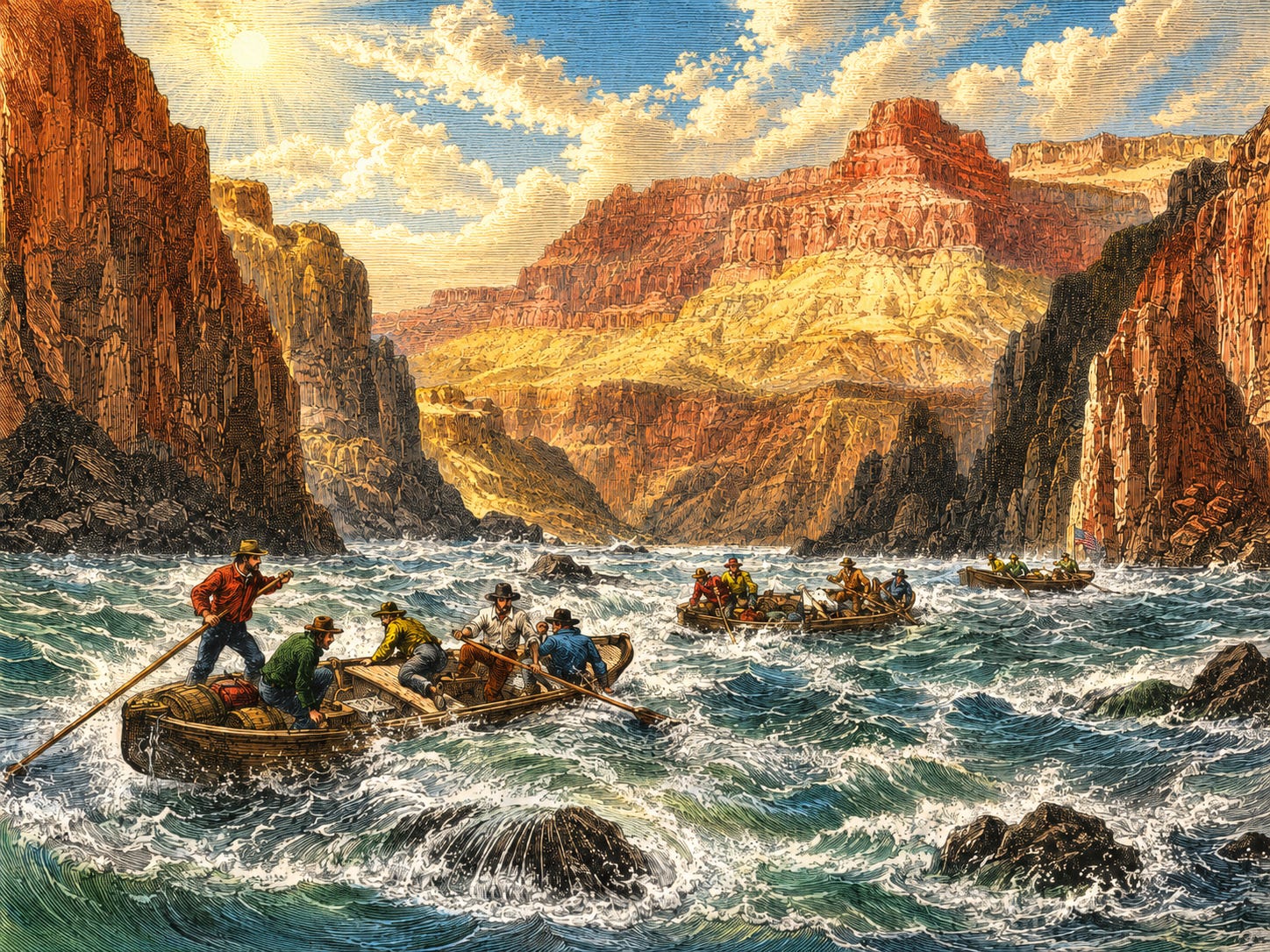
Last summer I drove in the shadow of Mount Yale, a 14,000 foot tall Colorado peak first climbed in 1869 by Josiah Whitney and a crew of, ironically, Harvard researchers. Named in honor of Elihu Yale—the primary benefactor of the eponymous university—the mountain is a tribute to the brave Easterners who settled the American West. Many of them were Harvard men. Others Yalies. Others yet Dartmouthians. They named creeks and cricks and peaks after themselves and their alma maters. And yet some of the greatest explorers were of a different variety altogether. They were Western men.
The Western man of the 19th century, before the homogenization of America’s regional sub-cultures, was educated “low and West.” Schoolhouses, where they existed, had no formal curricula. Eastern men, educated “high and East,” learned classical language and were intellectually formed by the Trivium (grammar, logic, rhetoric). Western men took whatever was thrown at them, often amounting to spelling, basic moral lessons, geography, and elementary history. Much of their education happened outside of the classroom, where they imbibed practical knowledge about agriculture, forestry, and land management from experience. Indeed, a Western education was, above all, practical. Its concern was transmitting enough knowledge to get young boys and girls prepared for life on the frontier of American civilization—leisure was wasted time, and education was a blunt force instrument necessary for the Baconian experiment that was Manifest Destiny.
John Wesley Powell was the son of a Methodist preacher. Born in 1834, the year that the British Empire abolished slavery and President Andrew Jackson was censured by Congress, Powell was a son of Mount Morris, New York, just south of Rochester. His father braved the Atlantic Ocean three years prior, immigrating to the fledging Republic from Shrewsbury, England. Powell’s childhood followed his father’s preaching, taking him to Ohio, Wisconsin, and finally, Illinois. Named after John Wesley, the famed Methodist preacher, Powell was raised in an incredibly religious milieu. As a young boy, Powell was assaulted by fellow schoolboys because of his father’s dogged, Gospel-inspired abolitionism. Writing to William Wilberforce in 1774, John Wesley described slavery as “the scandal of religion, of England, and of human nature.” Powell, and Powell’s father, agreed.
Where Powell’s early childhood was dictated by his father’s circuit-riding, his late childhood was dictated by wilderness expeditions. In his late teens, Powell met a mentor by the name of George Crookham. Crookham was a self-taught naturalist, historian, geologist, ethnologist, and zoologist—a rural savant.
“In an extraordinary number of cases,” wrote Wallace Stegner, “that first man of learning or enthusiasm that a frontier boy encountered gave his life a twist that it never outgrew.” Abe Lincoln’s first mentor was a lawyer. Powell’s was Crookham. Crookham’s influence on Powell’s life is inestimable: “it was an influence calculated to make Powell a leading citizen of some rural Athens, a member of the debating club, a lecturer on Lyceum circuits, a pillar of the crude structure that learning was building in the wilderness.”
“In an extraordinary number of cases,” wrote Wallace Stegner, “that first man of learning or enthusiasm that a frontier boy encountered gave his life a twist that it never outgrew.”
Soon Powell became a naturalist in his own right, learning from fossil-collecting and studies necessitated by his occasional teaching at various schoolhouses. In 1860, he won a prize for his mollusk collection from the Illinois State Agricultural Society.
At the age of 27, having cast a ballot for Lincoln less than a year prior, Powell volunteered to serve in the 20th Illinois Infantry. Within a month he was mustered into federal service. After taking a brief leave of absence to marry Emma Dean, Powell went back to the front lines. At the battle of Shiloh in 1861 his right arm was severed by a Confederate Minié ball. He recovered quickly, and opted to serve out the rest of the war instead of enjoy an honorable discharge. At Vicksburg and various other now-famous locales, he spent his free time analyzing geological formations and collecting more fossils. By the time of General Lee’s surrender at Appommatox, Powell was a brevet lieutenant colonel, though he opted for the title of “Major” for the rest of his life.
After the war, Major Powell joined Illinois Wesleyan University as a professor of geology, passing on much of what he learned from Crookham to eager students. He soon after joined Illinois State Normal University, armed with “a confidence and dash and capacity to manipulate men that nothing but the army could have taught him so fast.” Powell secured a grant from the legislature in Springfield to support the Illinois Natural History Society and provide himself a salary of $1,500 to serve as curator of the Society’s increasingly voluminous collection. Some time during this period, a desire grew in him to go West and explore what he dubbed the “Plateau Region”—a hitherto uncharted land spanning southern Utah and the northern reaches of the Arizona Territory. The rest is history, as they say. Powell became the first man to navigate the entire length of the Colorado, embarking on multiple expeditions down the Green River and into the mile-high canyons of what would come to be called the Grand Canyon. He was appointed the second director of the United State Geological Survey (USGS) in 1881 by President James Garfield, serving until 1894.
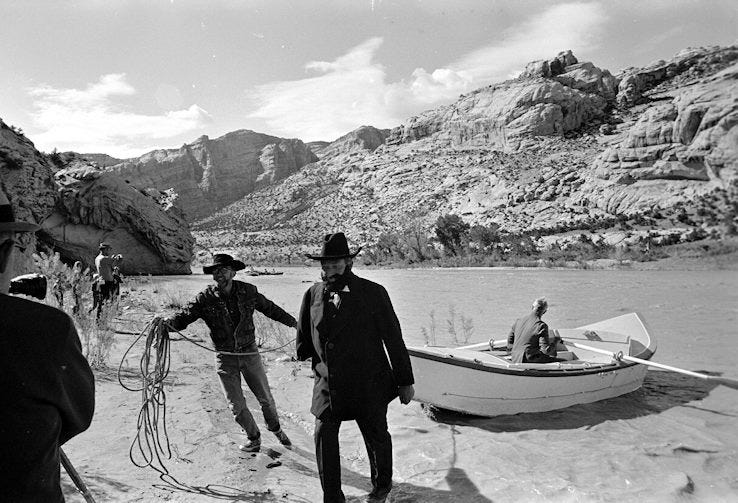
Powell’s education was definitionally deficient. He was introduced to neither Aristotle nor Cicero as a boy. He learned hard work managing a country farm at the age of 12; botany, geology, and natural science from Crookham; how to lead men and persevere in great endeavors from the Battle of Shiloh. His school was the school of hard knocks. Experience, supplemented by an insatiable desire to answer the many questions pulsing through his brain, sufficed for his education. Like many Western boys, he was anxious to get his hands on any book he could find, lusting to satiate a thirst for knowledge that nothing this side of Heaven could quench. He did at times interact with formal institutions of higher learning, but never graduated. He was often distracted by expeditions and invitations to lecture at Young Men’s Lyceums. In other words, John Wesley Powell was no Henry Adams.
George Washington, the greatest of America’s founders, was also the least educated. Unlike his learned compatriots, Washington was remarkably under-read. It was one of his great insecurities. While it may be said that he succeeded in spite of his rudimentary education, Powell’s experience suggests that he succeeded precisely because of it. It was not in the schoolhouse but at Valley Forge that Washington acquired the skillset required to lead America in its most formative years: If he was to keep his post, if the Continental Army was to be more than a firefly in the long night of history, Washington would need to knit together the interests and affections of militias hailing from 13 different colonies that did not yet consider themselves citizens of the same nation.
Powell was a prophet, an American Jeremiah, who urged caution and reason at a time when his fellow countrymen were possessed by wishful thinking. Boosters and swindlers, a common type bred by the frontier, believed that the West was a land of boundless resources that could be extracted with impunity. It was this pride that nearly extinguished the American buffalo, relegated few surviving American Indians to reservations, and led too many antsy young men to their deaths in mine pits and boom town bars.
Powell’s education—one grounded in experience—taught him moderation and prudence. His experience of the West taught him its limits. The West would only be settled successfully if its laws and mores accorded with the climate. If Old World conceptions of water rights, land use, and agriculture were taken as Gospel, the project of the frontier would collapse upon its own edifice. Yet despite his keen understanding of the West’s limits, Powell was an explorer; a man unwilling to sit still; a man whose quest for knowledge frequently took him west of the 100th meridian and into the thrashing waters of the Colorado. One is reminded of Xerxes, preparing to cross the Hellespont and initiate an invasion of Greece. His dreams urged him on; his vizier urged caution. Both temptations—taking risks and taking precautions—co-mingled in Powell’s soul. It was his education that uniquely prepared him to balance them; to exercise clear-eyed courage where others urged recklessness.
One is reminded of Xerxes, preparing to cross the Hellespont and initiate an invasion of Greece. His dreams urged him on; his vizier urged caution. Both temptations—taking risks and taking precautions—comingled in Powell’s soul. It was his education that uniquely prepared him to balance them; to exercise caution where others urged recklessness.
In our time, when Americans lust for a hint of hope, perhaps Powell would’ve taken a different tack, in the spirit of Blaise Pascal: “If he exalts himself, I humble him. If he humbles himself, I exalt him.” But most of Powell’s contemporaries were prideful; exalted beyond good reason. He was a prophet fit for his time. A prophet that saw into the future not by building castles of cloud, but by navigating his nation on foot. He had the courage to dream. And his dreams, anxious to come true, were grounded in the sober quarry of reason.
On a cool September day at his summer home in Maine, the Methodist-born son-of-a-preacher died a great man—the kind of great man that can only be forged by the crucible of experience.